
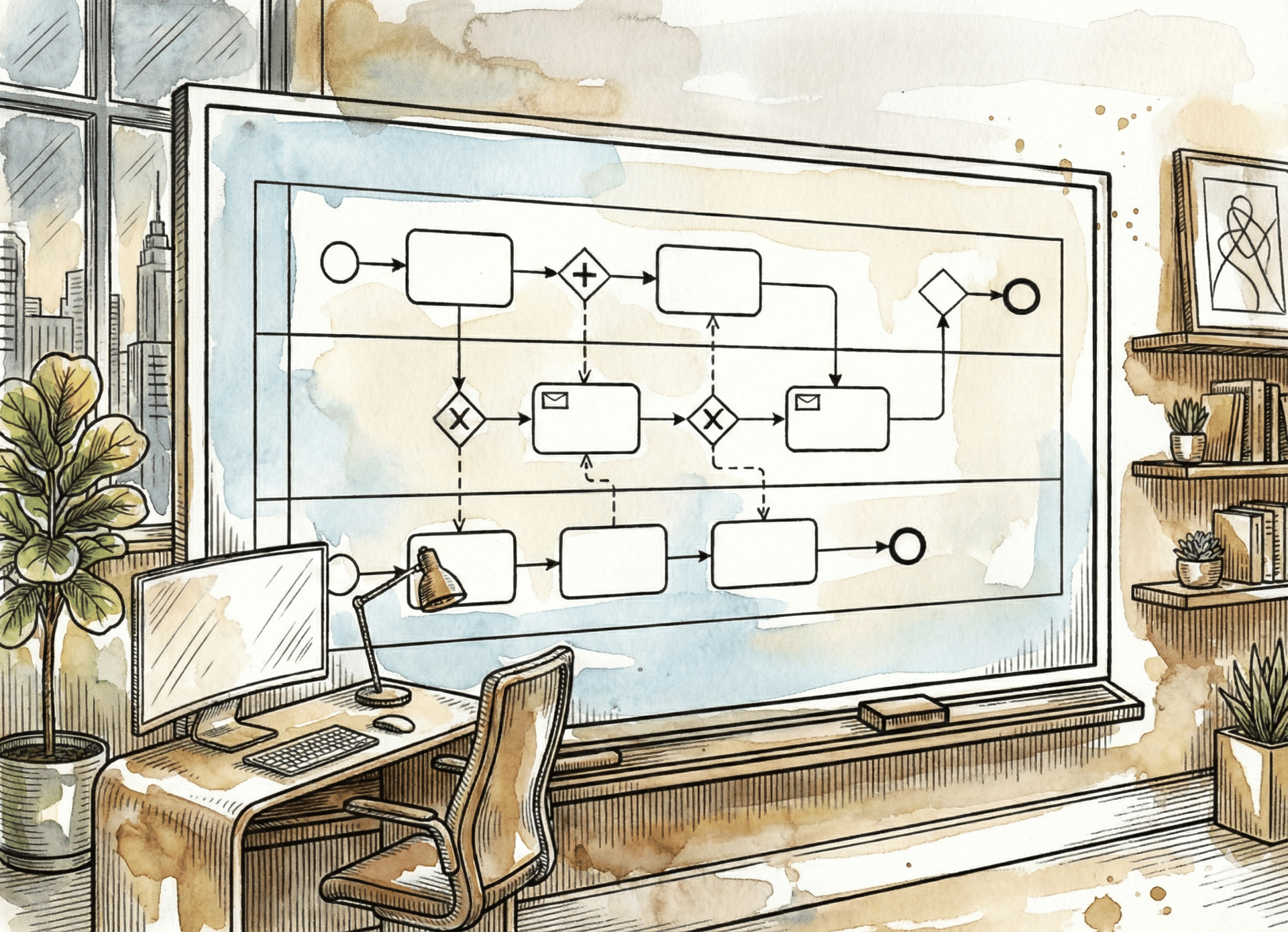
Even highly rigorous teams can struggle to maximize business impact. This case study shows how we realized that execution quality alone weren’t enough and how optimizing resources and ways of working led to better results.
Problem-driven research process
My role
Gabriel Bueno
UXR Lead (Responsible)


Carla Vitorino
Head of UX (Accountable)


Alessandro Lima
UX Lead (Consulted)
UX Lead (Consulted)
Rodrigo Garcia




Fernanda Torres
IC UXR (Consulted)


Marco Boareto
IC UXR (Consulted)


Rute Harada
IC UXR (Consulted)


Ramon Araújo
IC UXR (Consulted)
Stakeholders


Timeline
Methods
Tools
Artifacts
1 month
HC Design Process; BPMN
Miro, Notion, Powerpoint
Flowchart; Research Playbook; Problem Framing Framework;


When I assumed leadership of the research team at Uol Edtech / Passei Direto, I identified three key issues:
Situation
Deliverables were praised for technical quality but were often seen as not sufficiently relevant to the broader team.
Complex research projects often took up to eight months to complete.

There was a lengthy backlog of research requests, leading to unmanageable lead times.
Tasks
I made a proposal for my managers and key stakeholders: to rethink our ways of working in order to achieve the desired outcomes for the research team. That will lead us to a complete redefinition of:
The mission I took ownership of
Strategy
Vision
Processes
Role and responsibilities



1. Diagnosis
ACTIONS
Research teams typically support decision-making across the company, but at that time we were struggling to get a seat at the table with decision-makers, even though we were delivering high-quality studies.
We ran a retrospective of our past work and found that, although our research execution was highly rigorous, it was often focused on the wrong problems.
Based on that understanding, we concluded that the best way to become more relevant across teams was to help the company to identify and investigate the right problems.
How I made it happen
Besides, we recognized we were operating reactively. We had no proactive projects and were chasing after a lengthy backlog of short-term & low-impact research requests.
Finally, we understood we weren’t prioritizing the backlog. And we didn’t know which requests to prioritize because we didn’t know our priorities as a research team.
2. Set the strategic foundation
We needed to define our priorities. To adress this, we decided it was the right moment to define a clear vision for the future and build a new strategy for the research team.
After several rounds of discussions within team and broader stakeholders, we set out a new vision:
“Be a research team that works in the problem space, drives efficient decision-making, and helps the company accomplish its medium and long-term objectives".
This helped us to prioritize projects and focus on strategic work, leading to medium and long-term discussions across the company.
You can find more details about the vision here, in Research Vision and Roadmap.
3. Design the new Research Process
Once we defined what we should do, we moved on to define how we should do it.
It was clear that we were reliable at technical execution of the projects. So we focused on adjacent activities and came up with a seven-step research process organized into three phases:
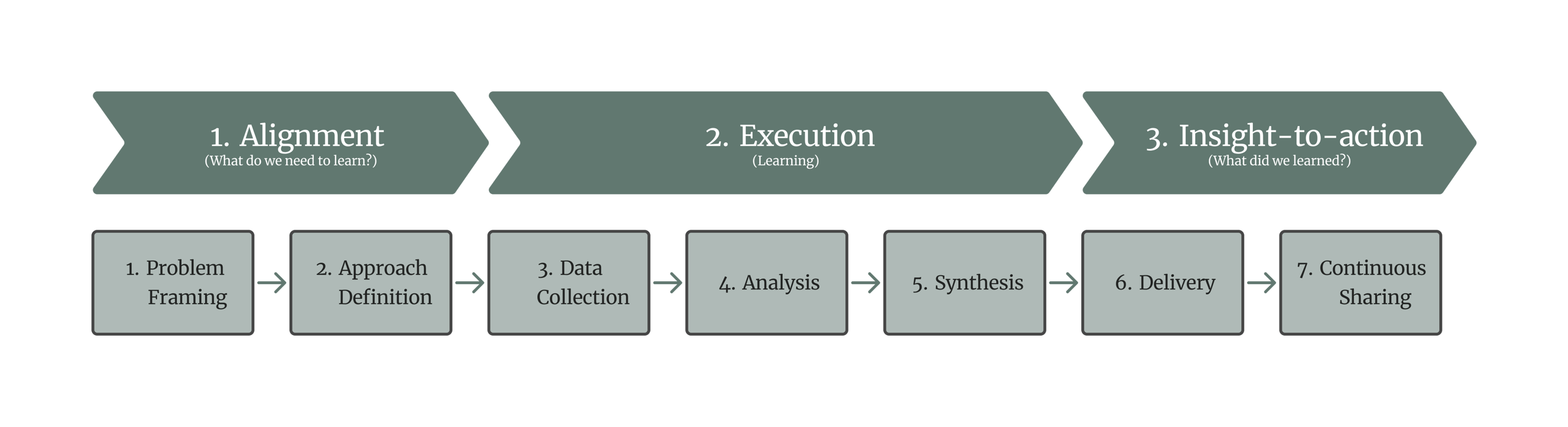
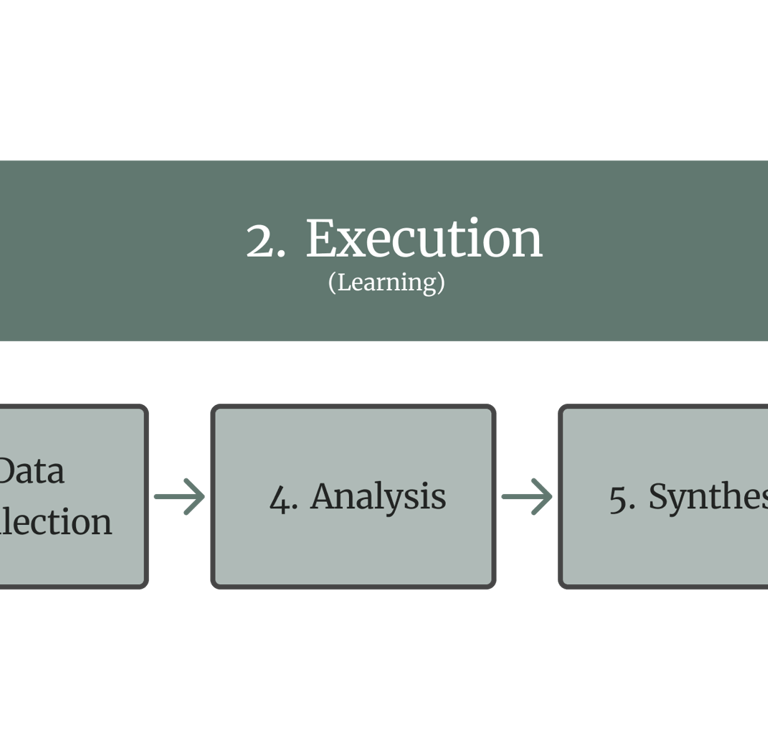
We define together what problem we’re trying to solve and mainly what we need to learn throught the research.
To achieve these goals, a problem-framing framework was introduced in the first step.
In Alignment, we propose to foster collaboration among stakeholders (designers, PMs, data, engineers, etc.)
Then, we we’re able to decide the appropriate methods.
At Execution, the hands-on phase, we should execute the chosen methods. That’s the learning phase.
We create the research plan, gather and analyse data and develop the research synthesis.
In the Insight-to-Action phase, we share what we learned about the problem and outline paths to solve it.
We also propose commit to continuous articulation of insights through a ongoing sharing practices- presentations, syncs, sensitization workshops and newsletters.
All these proposals were made believing that Alignment and Insigh-to-Action phases were the key to improve research relevance and impact at the company.
4. Deliver the artifacts
Implementing new processes is a change management challenge. It requires team members to develop a new mindset and take ownership.
These needs led us to the following five artifacts:
Executive Deck
1.
2.
Process Flowchart
3.
Research Playbook
4.
Problem-Framing Framework
5.
Seniority Leveling Guide
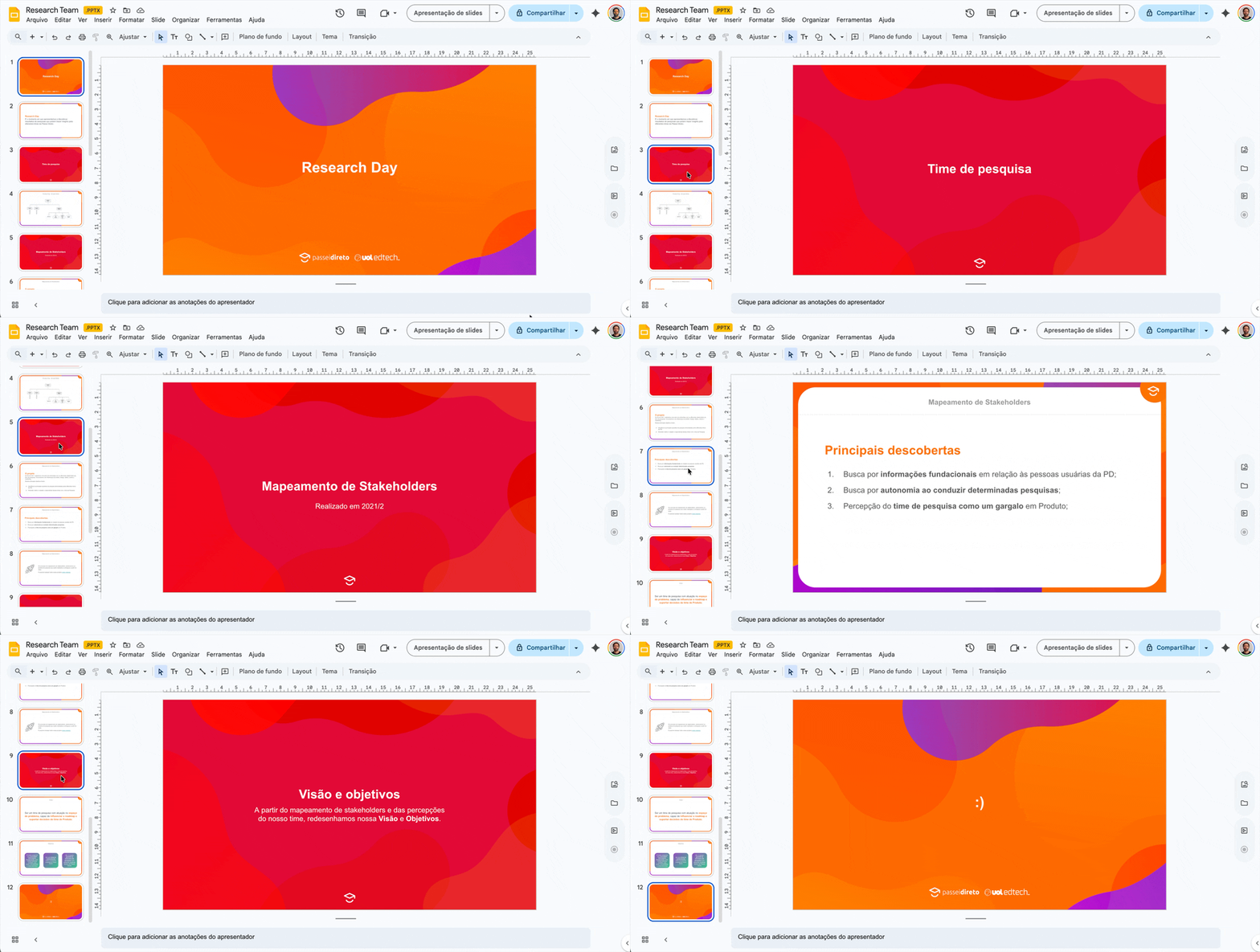
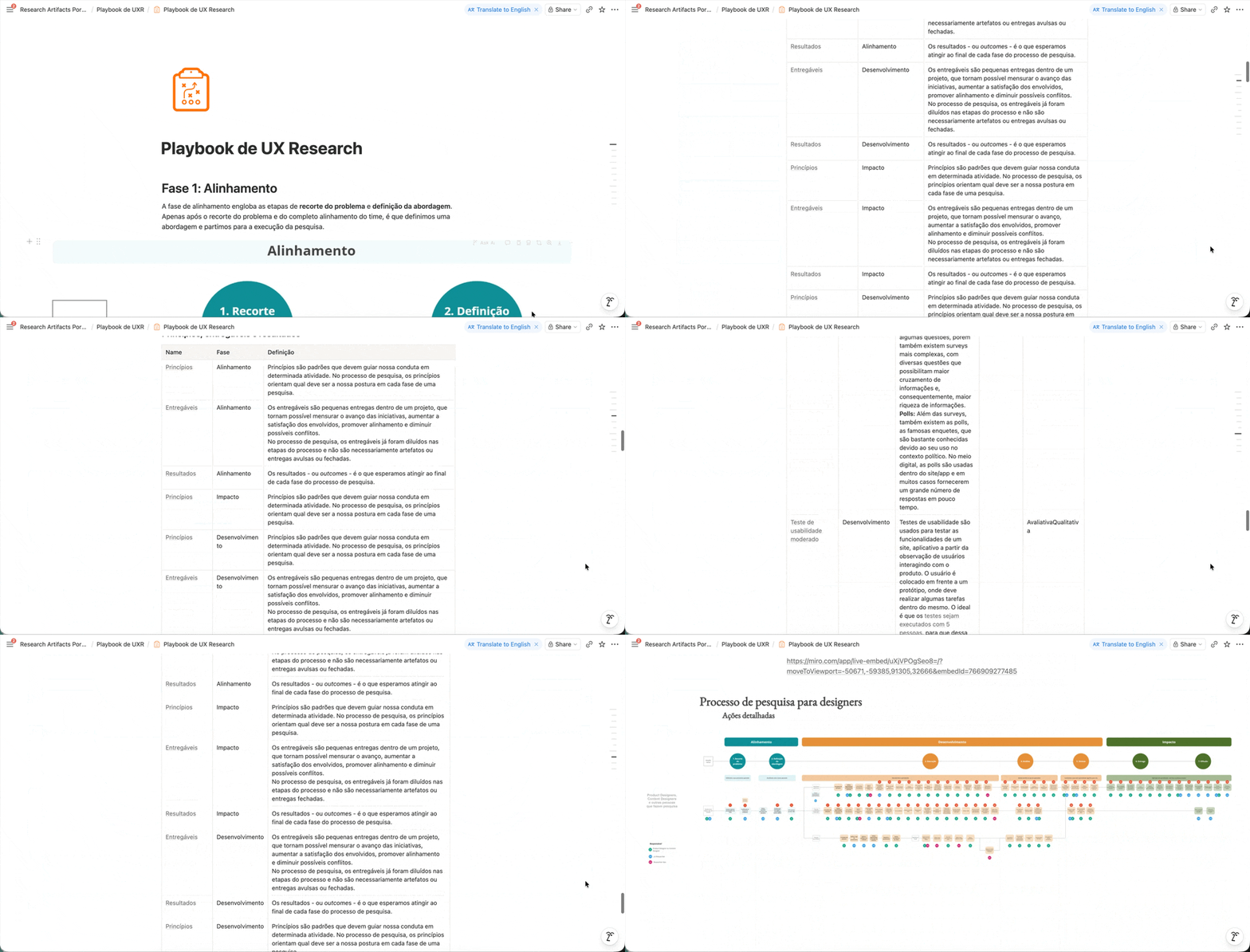
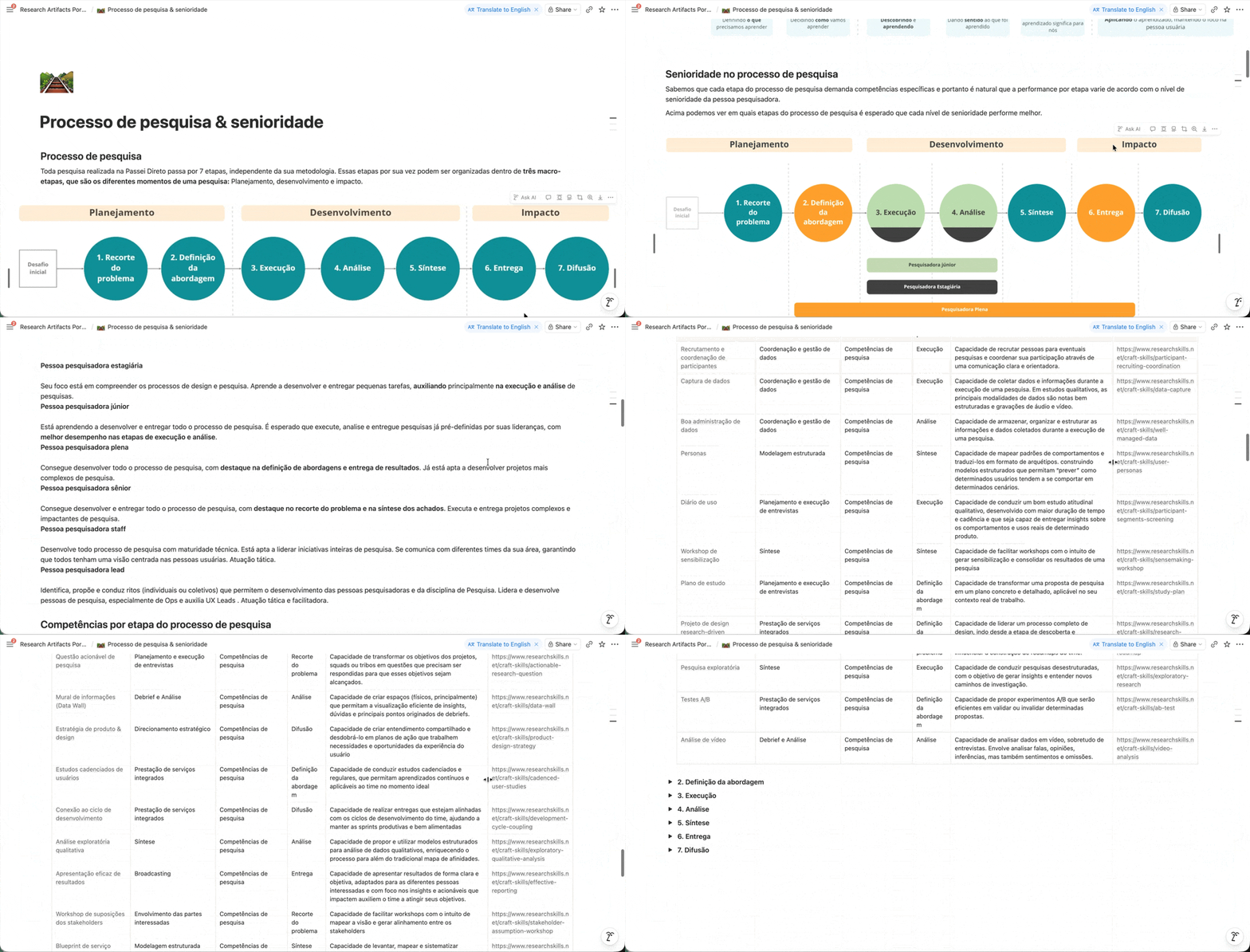
Several executive presentations about research team’s strategy and its operationalization through the new process and its key propositions. For instance, the focus on problem reframing.
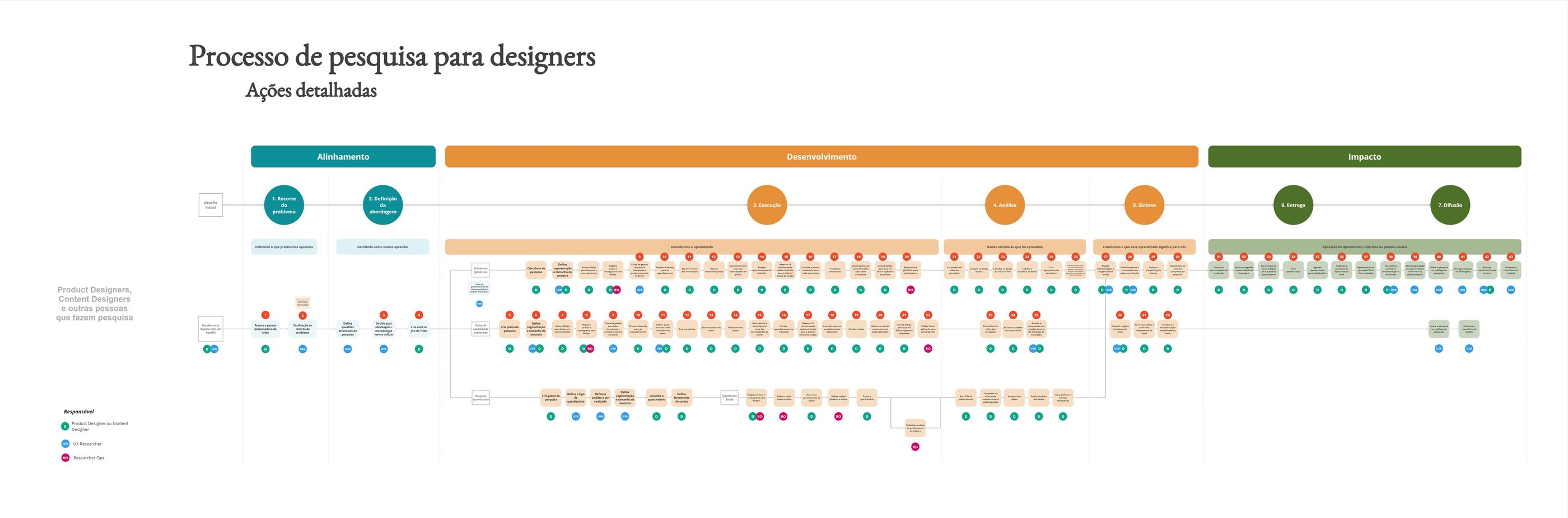
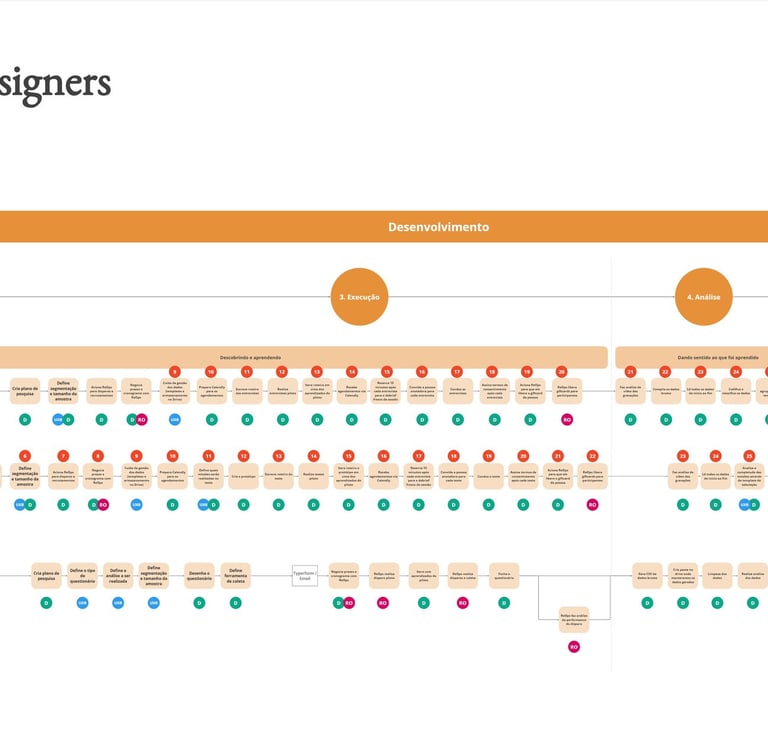
A complete research process flowchart with each action and its owner—researcher or designer
An updated Research Playbook with guidelines for each step and phase, such as the mandatory Problem Framing step
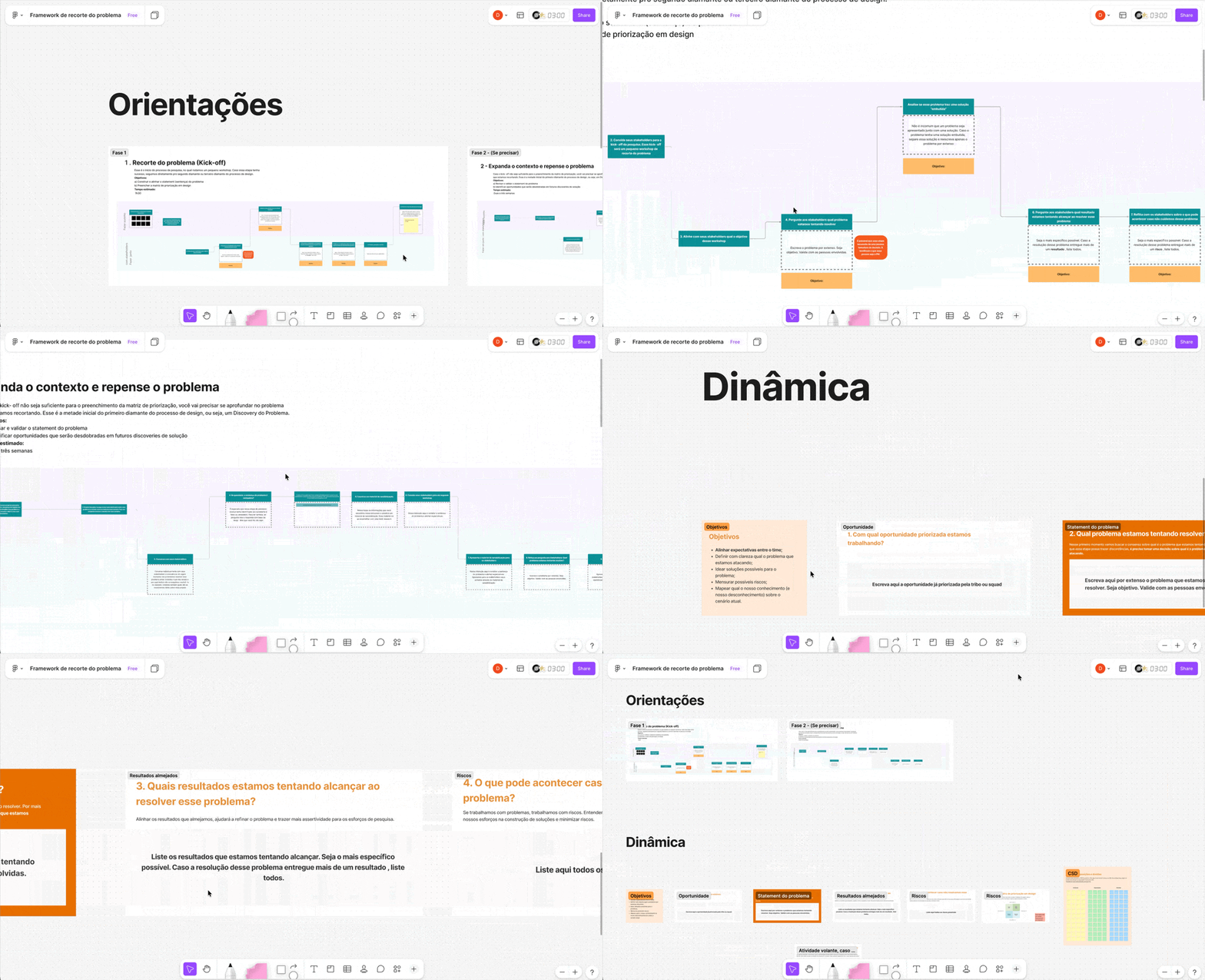
A problem-framing framework itself, based on stakeholder alignment and co-writing the problem statement with project stakeholders.
This framework allowed us to identify when we truly needed new research or when we could make decisions based on existing information.
A guide outlining expected performance by researcher seniority level, to align expectations among managers and leadership across the company.
The impact I delivered
RESULTS
We archived all requests we understood to have enough information for decision-making. The remaining requests were split into problems to be solved by design (build solutions) and problems to be solved by research.
Besides, the problem-framing framework allowed us to identify when we truly needed new research or when we could take decisions based on previous information.
Relevance.
Since we focused on problem-framing and alignment, we started delivering more actionable insights more suited for decision-making across the company. The work became truly relevant.
Focusing on medium and long-term efforts increased the strategic impact of research. We started to manage more complex and future oriented topics, while the product teams were responsible for short-term projects.
That helped us access strategic discussions and scale our impact across the company.
We established deadlines for research projects: even the most complex studies must be completed within three months, with milestones to share findings.
Shifting the role toward sense-making and facilitation drove more mature performance among researchers. Soft skills were highly developed
Now, besides the quality of their work, they were also more influential across teams.
The new process gave us the operacional efficiency and the freedom to become more proactive.
Soon, we were able to propose and execute our own roadmap.
In the end, we successfully addressed all the previously identified issues. By focusing on the right problems, we became more relevant and precise in our approach. This clarity enabled us to define clear deadlines, bring the backlog up to date, and shift from reactive tasks to more proactive work.
Influence.
Antecipation.
Agility.
Predictability.
Proactivity.



WHAT'S NEXT?
Would you like to discover how this project became just the starting point of my journey as a leader?
Let’s talk :)